


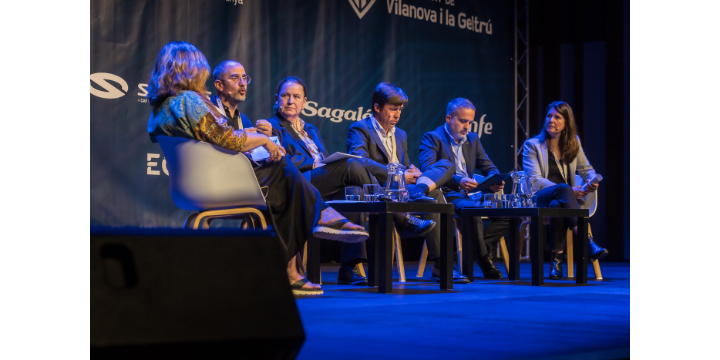
From Catalonia Logistics Cluster, we took part in the Catalan Mobility Conference, held in Vilanova i la Geltrú and organized by AMTU and the Ajuntament de Vilanova i la Geltrú, among other entities from the sector.
The day began with the institutional welcome by AMTU President Mar Molina and the Mayor of Vilanova i la Geltrú, Joan Luis Ruiz. Subsequently, the planned activities for the day were carried out, including an expert conversation with Miquel Serracanta of Supply Chain Talent and Carmen Javierre of Grup Giró, two panel discussions, and a visit to the Vilanova fish market, among others.
Our manager, Marta Losada Martín, participated as a panelist in one of the roundtables titled “Logistics in the Country”, along with Manuel Valdés of the ATM, Carmen Ruiz of CIMALSA, Gerard Llobet of the Vilanova i la Geltrú City Council and Ramón García of the Centro Español de Logística, where the strategic role of logistics in mobility, territorial competitiveness, and quality of life in cities was addressed.
During the session, it was made clear that logistics is no longer invisible, but rather a structural element of the country's economic and social functioning. In this regard, it was highlighted that logistics acts as the circulatory system of the economy, essential for ensuring commerce, industry, the restaurant sector, and the full range of services, as well as for advancing the energy transition.
The debate has prompted reflection on the need to manage logistics from a strategic, rather than secondary, perspective, with a key role for local authorities in its planning and regulation. It has been emphasized that the question is not whether we want logistics or not, but how we can govern it more effectively to ensure a balance between economic activity, sustainability, and urban coexistence.
One of the central points of the discussion was the challenge of the last mile, where mobility, urban planning, commerce, and sustainability converge. In this area, the need to strengthen collaboration between public administrations and the private sector has been emphasized, as well as to promote more flexible and coordinated models that allow for adaptation to the needs of different municipalities.
The main trends in the logistics sector were also shared, such as digitalization as an essential element for urban distribution, the transition to more sustainable models with the associated costs, the talent and generational succession challenge, and the need to intensify collaboration among all stakeholders in the value chain.
Likewise, we have highlighted the lines of work we are currently developing from the Cluster, such as projects related to urban goods distribution (DUM), connection platforms between industry stakeholders, pilot tests with innovative solutions like autonomous robots, training programs on digitalization, as well as studies on distribution patterns and territorial analyses to anticipate impacts in climate emergency scenarios.
From the Cluster Catalonia Logistics, we continue to actively participate in forums like this, which allow us to share knowledge, drive innovation, and advance toward more sustainable, intelligent, and competitive logistics models.


Comments